Watch: the latest on Claude and Claude Code
All videos →
I Have Spent 1000+ Hours With Claude Code. This Is What I LearnedThe Coding Sloth · Aug 18, 2026

How the Claude Code team uses Claude CodeClaude · Sep 2, 2026

I Tried 100+ Github Repos for Claude. These 6 Are the BestNate Herk | AI Automation · Oct 11, 2026

Claude Code Full Course 2026 | How Senior Engineers Actually Build with AIJavaScript Mastery · Sep 25, 2026

Claude Code Full Course – Autonomous Goals, MCP, and VS Code SetupfreeCodeCamp.org · Aug 5, 2026

How To Use Claude Code In Visual Studio Code - Step by StepMikey No Code · Sep 22, 2026
Claude, right now
Updated July 2, 2026. With Fable 5 restored and Claude Sonnet 5 launched June 30, here is the full Claude line-up you can use today, and which to reach for.
| Model | ID | Best for | Price /MTok |
|---|---|---|---|
| Claude Fable 5 | claude-fable-5 | The flagship — restored July 1; hardest problems, longest autonomy | $10 / $50 |
| Claude Opus 4.8 | claude-opus-4-8 | The daily default, hard reasoning, agents, long autonomous work at half Fable’s price | $5 / $25 |
| Claude Sonnet 5 | claude-sonnet-5 | New Jun 30 — the budget agent runner; default on Free & Pro | $2 / $10 intro thru Aug 31, then $3 / $15 |
| Claude Sonnet 4.6 | claude-sonnet-4-6 | Prior workhorse, superseded by Sonnet 5 | $3 / $15 |
| Claude Haiku 4.5 | claude-haiku-4-5 | Cheapest & fastest, high-volume, simple tasks, classification | $1 / $5 |
On a paid Claude plan or in Claude Code, Opus 4.8 remains the daily lean; save Fable 5 for the work only it can do, especially while it’s included at 50% of weekly limits through July 7. The chapters below document Fable 5 in full.
What Fable is
▶ Back in service. Fable 5 was pulled by US government order on June 12, 2026 and restored worldwide on July 1 after the controls were lifted. Everything below documents it as released, and available again.
Fable 5 is Anthropic's most intelligent model, a new tier above Opus, the way Opus sits above Sonnet. Announced June 9, 2026, it is state-of-the-art on nearly every benchmark Anthropic tested, works autonomously for longer than any previous Claude, and is more token-efficient doing it.
It arrives with an unusual companion. Fable 5 is what Anthropic calls a Mythos-class model made safe for general use. Mythos 5 is the same underlying model with safeguards lifted in specific areas, restricted to vetted partners doing security and life-sciences research (Chapter VII). Fable is the version you and your API key can have.
| Property | Value |
|---|---|
| Model ID | claude-fable-5 — use this exact string; no date suffix |
| Context window | 1,000,000 tokens |
| Max output | 128,000 tokens (streaming required for large outputs) |
| Thinking | Adaptive only, the model decides when and how deeply to think |
| Structured outputs | Supported (output_config.format) |
| Vision | State-of-the-art, high-resolution image input |
It shares its API surface with Opus 4.7 and 4.8 — if your code runs on those, it runs on Fable with a one-line model swap, plus one new rule covered in Chapter V.
What it can do
| Benchmark ↕ | Area ↕ | Fable 5 result ↕ | Source ↕ |
|---|---|---|---|
| SWE-Bench Verified | Software eng. | 95.0% | Independent testing |
| Hebbia Finance Benchmark | Knowledge work | 90%+ — first to break 90 (+10 vs Opus) | Hebbia |
| BenchLM | General | #2 of 123 models | BenchLM leaderboard |
| FrontierCode | Software eng. | Highest among frontier models (medium effort) | Cognition |
| CursorBench | Long-horizon coding | State of the art | Cursor — Michael Truell |
| GitHub agentic tasks | Software eng. | Exceeded previous benchmarks for autonomy | GitHub — Mario Rodriguez |
| Vision (Pokémon FireRed) | Vision | Completed vision-only, minimal harness | Anthropic announcement |
| Slay the Spire (memory) | Long context | 3× improvement vs Opus 4.8 with a memory file | Anthropic announcement |
| Frontier physics research | Reasoning | ~GPT-5.5's 4-day result in 36h, ⅓ the tokens | Notation Capital — M. Pines |
Click any heading to sort. Figures as reported by each source; provisional leaderboards move and methods vary. See Anthropic's full official chart →
Software engineering
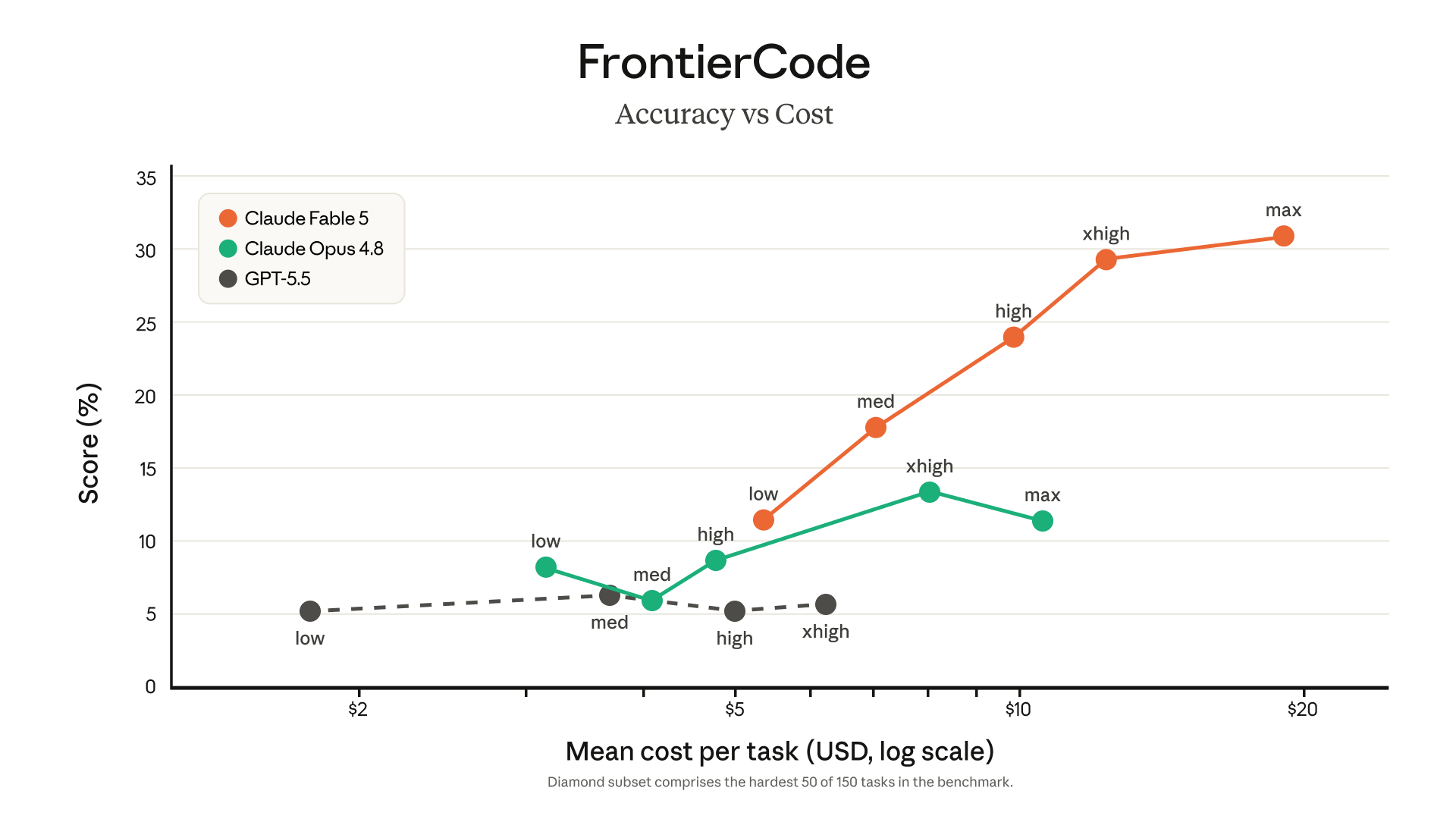
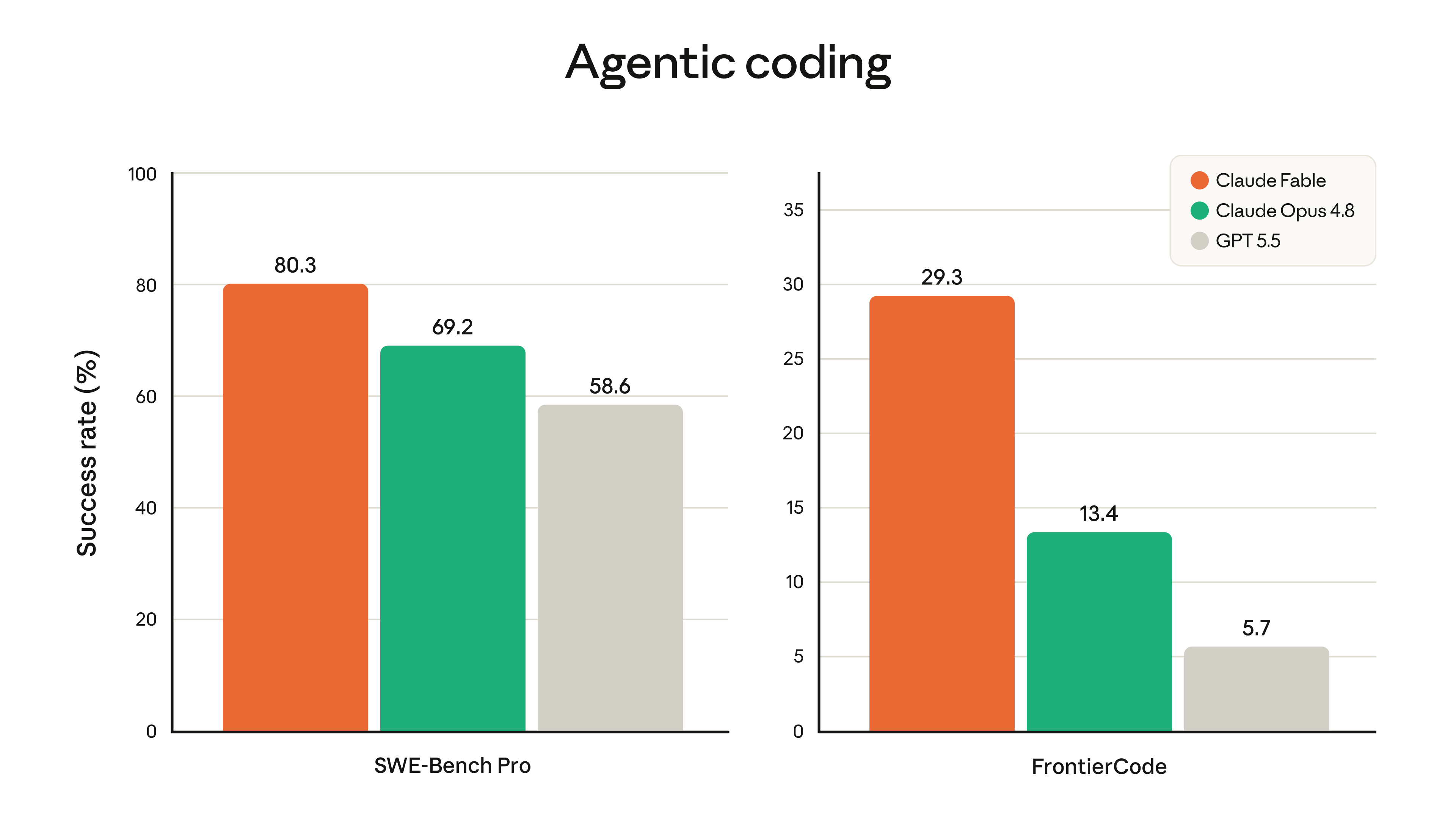
This is where the early stories are loudest. Stripe reported Fable 5 compressed months of engineering into days, including a 50-million-line Ruby codebase migration finished in one day that a team had scoped at two months. On Cognition's FrontierCode evaluation it posted the highest score among frontier models, at medium effort.
"State of the art model on CursorBench. Opened up a class of long-horizon problems out of reach for earlier models."— Michael Truell, CEO & Co-founder, Cursor
"Took on complex, long-horizon coding tasks with a level of autonomy and reliability that exceeded previous benchmarks."— Mario Rodriguez, Chief Product Officer, GitHub
Knowledge work
Highest score on Hebbia's Finance Benchmark for senior-level reasoning, the first model to break 90% on their core analytics benchmark, a 10-point jump over Opus. Trading firm IMC said it "aced their trading-analysis evaluations nearly across the board." Strong document reasoning, chart and table interpretation throughout.
Vision
State-of-the-art on vision: it extracts precise numbers from dense scientific figures, rebuilds web-app source code from screenshots alone, and, the announcement's best party trick — completed Pokémon FireRed using vision only, with a minimal harness where previous models needed elaborate helper tooling.
Memory and long context
Fable stays focused across millions of tokens. Given persistent file-based memory in Slay the Spire, its performance improved 3× more than Opus 4.8's did, and it reached the game's final act 3× more often. The lesson for builders: give it a memory file, it actually uses one.
"Strongest model on frontier physics research while using a third of the reasoning tokens. In 36 hours it got nearly to where GPT-5.5 landed after four days."— Matthew Pines, CEO, Notation Capital
Where to get it, what it costs
The Claude API
Available everywhere as of June 9. On the API and consumption-based Enterprise it's fully available immediately. Pricing per million tokens, less than half the cost of the old Claude Mythos Preview:
| Model | ID | Input | Output |
|---|---|---|---|
| Claude Fable 5 | claude-fable-5 | $10.00 | $50.00 |
| Claude Opus 4.8 | claude-opus-4-8 | $5.00 | $25.00 |
| Claude Sonnet 5 | claude-sonnet-5 | $2.00 intro thru Aug 31, then $3.00 | $10.00 intro thru Aug 31, then $15.00 |
| Claude Sonnet 4.6 | claude-sonnet-4-6 | $3.00 | $15.00 |
| Claude Haiku 4.5 | claude-haiku-4-5 | $1.00 | $5.00 |
Twice the price of Opus buys the highest intelligence ceiling Anthropic ships, and its token efficiency claws some of that back. Route your hardest problems to Fable; keep high-volume routine work on Sonnet or Haiku.
Subscription plans
Claude Code
Fable 5 powers Claude Code, terminal CLI, desktop app, web app, and IDE extensions. If you'd rather use Fable than call it, that's the shortest path. Anthropic's own CTO put it this way:
"Delivers more capable engineering in fewer turns than prior models, handling complex multi-agent workflows our employees run daily in Claude Code."— Luke Anderson, CTO, Anthropic
Your first call
One request, three choices made for you: adaptive thinking on, effort high, and room to answer.
curl
curl https://api.anthropic.com/v1/messages \
  -H "content-type: application/json" \
  -H "x-api-key: $ANTHROPIC_API_KEY" \
  -H "anthropic-version: 2023-06-01" \
  -d '{
    "model": "claude-fable-5",
    "max_tokens": 16000,
    "thinking": {"type": "adaptive"},
    "output_config": {"effort": "high"},
    "messages": [{"role": "user", "content": "Explain CRDTs like a fable."}]
  }'
Python
import anthropic

client = anthropic.Anthropic()  # reads ANTHROPIC_API_KEY from the environment

response = client.messages.create(
    model="claude-fable-5",
    max_tokens=16000,
    thinking={"type": "adaptive"},
    output_config={"effort": "high"},
    messages=[{"role": "user", "content": "Explain CRDTs like a fable."}],
)
for block in response.content:
    if block.type == "text":
        print(block.text)
For long outputs, stream, the SDKs refuse non-streaming requests they estimate will outlive the HTTP connection:
with client.messages.stream(
    model="claude-fable-5",
    max_tokens=64000,
    thinking={"type": "adaptive"},
    messages=[{"role": "user", "content": "Write the design doc."}],
) as stream:
    for text in stream.text_stream:
print(text, end="", flush=True)The rules that changed
Fable follows the modern Claude API surface. If you're coming from older code, five things will bite, each is a clean 400 error, so you'll know.
| Old habit | On Fable 5 |
|---|---|
temperature, top_p, top_k | Removed, returns 400. Steer with prompting instead. |
thinking: {"type": "enabled", "budget_tokens": N} | Removed, use {"type": "adaptive"}; control depth with effort. |
thinking: {"type": "disabled"} | Fable-specific: an explicit disabled returns 400. To run without thinking, omit the thinking field entirely. |
| Assistant-turn prefills | Removed, use structured outputs (output_config.format) or a system-prompt instruction. |
Large max_tokens without streaming | Stream anything above ~16K output tokens. |
thinking: {"type": "adaptive", "display": "summarized"} — otherwise the long pause before output is the model thinking with nothing to show.Moral: don't tune the dials, state the task. Fable rewards a clear goal over a clever configuration.
Getting the most out of it
Pick an effort, then iterate
output_config.effort sets how hard Fable works, thinking depth, tool-call consolidation, and verbosity all scale with it. Five levels: low, medium, high (the default), xhigh, and max. Start at high; use xhigh for coding and agentic runs; reserve max for problems where correctness outweighs both cost and latency. Remember FrontierCode: Fable took the top score at medium — higher effort up front often lowers total cost on agentic work, because better planning means fewer turns.
Give it the whole task at once
Fable's long-horizon strength comes out when the full specification arrives in one well-written first turn, the goal, the constraints, and what "done" looks like. Drip-feeding requirements across turns wastes its planning; a complete brief lets one run carry the work end to end. That's how a 50-million-line migration fits in a day.
Give it a memory file
The Slay the Spire result generalizes: agents that keep notes outperform agents that don't, and Fable is markedly better than its predecessors at writing and using file-based memory. A scratchpad file and one line of system prompt ("check your memory file before starting; write new findings to it") is the cheapest capability upgrade available.
Structured outputs over parsing
response = client.messages.parse(
    model="claude-fable-5",
    max_tokens=16000,
    messages=[{"role": "user", "content": document}],
    output_format=ContactInfo,  # a Pydantic model, validated for you
)
contact = response.parsed_output
Cache your prefix
With a 1M-token window and $10/MTok input, prompt caching is not optional at scale. Mark the stable prefix with cache_control: {"type": "ephemeral"}; reads cost ~10% of base input price. Fable's minimum cacheable prefix is 2,048 tokens, and any byte change in the prefix invalidates everything after it, keep system prompts frozen and put volatile content last.
Budget long agentic runs
For autonomous loops, task budgets (beta header task-budgets-2026-03-13) give the model a token allowance it can see and self-pace against — output_config.task_budget: {"type": "tokens", "total": N}, minimum 20,000. Unlike max_tokens, the model is aware of it and wraps up gracefully as it runs down.
Use it in VS Code and GitHub
Step-by-step setup for the VS Code extension, Visual Studio, GitHub Actions, Code Review and worktrees: Claude Code in VS Code, Visual Studio and GitHub, plus 30 current videos.
Learn from the best
For the people and channels worth following on Claude and Claude Code, on YouTube, X, LinkedIn and Reddit, see who to follow on Claude.
The wilder twin: Mythos 5 and the safeguards
Every fable has a creature too powerful to let loose. Anthropic's answer was to ship two versions of one model: Fable 5, guarded for everyone, and Mythos 5, unguarded in narrow domains for vetted researchers.
How Fable's safeguards work
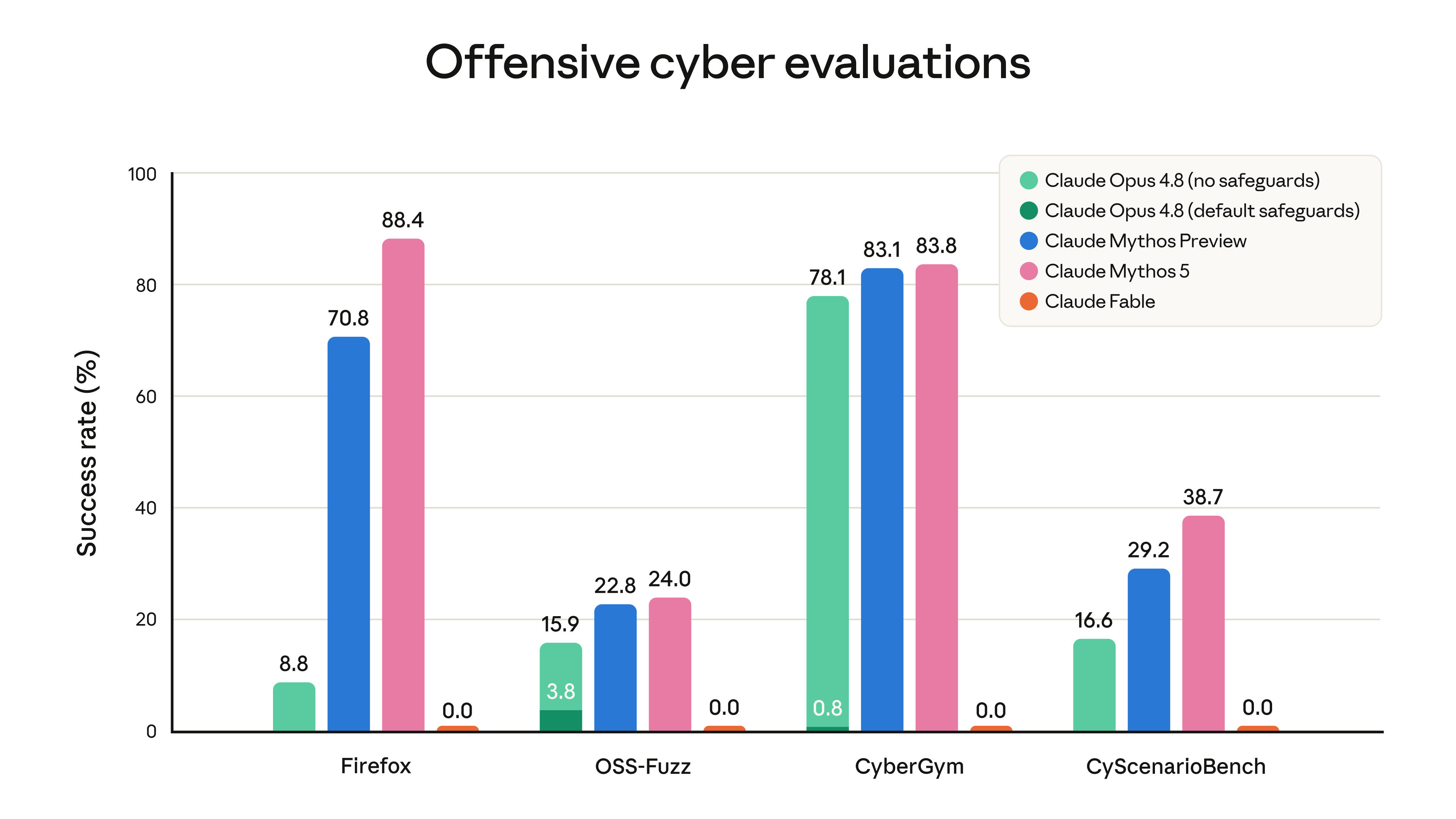
Classifiers watch three areas — cybersecurity (vulnerability discovery, exploitation, offensive cyber tasks), biology & chemistry (bioweapons-adjacent queries), and distillation (attempts to extract the model for training competitors). They trigger on less than 5% of sessions on average. When one trips, the response is handled by Claude Opus 4.8 instead, so 95%+ of sessions never see a fallback at all.
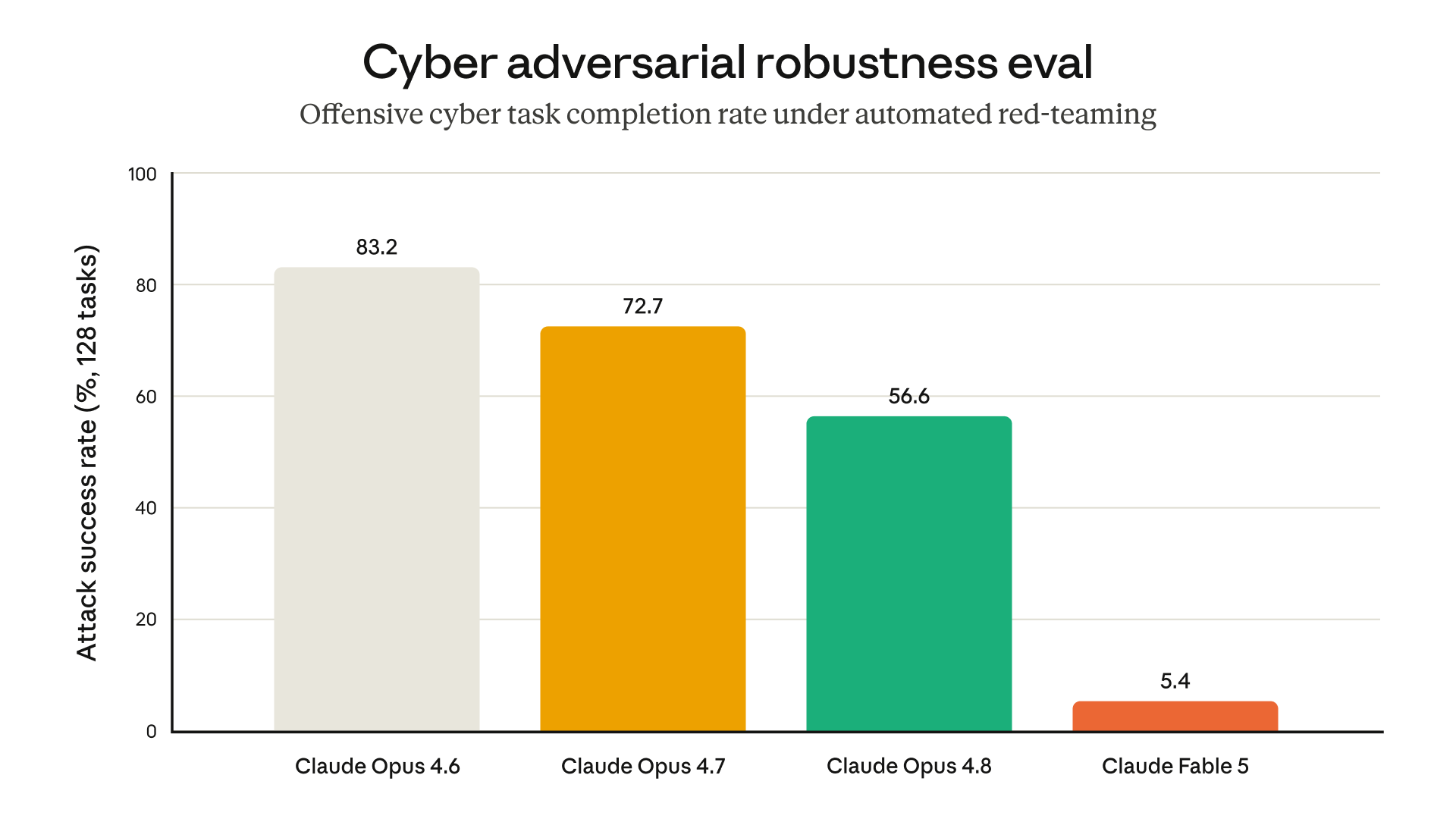
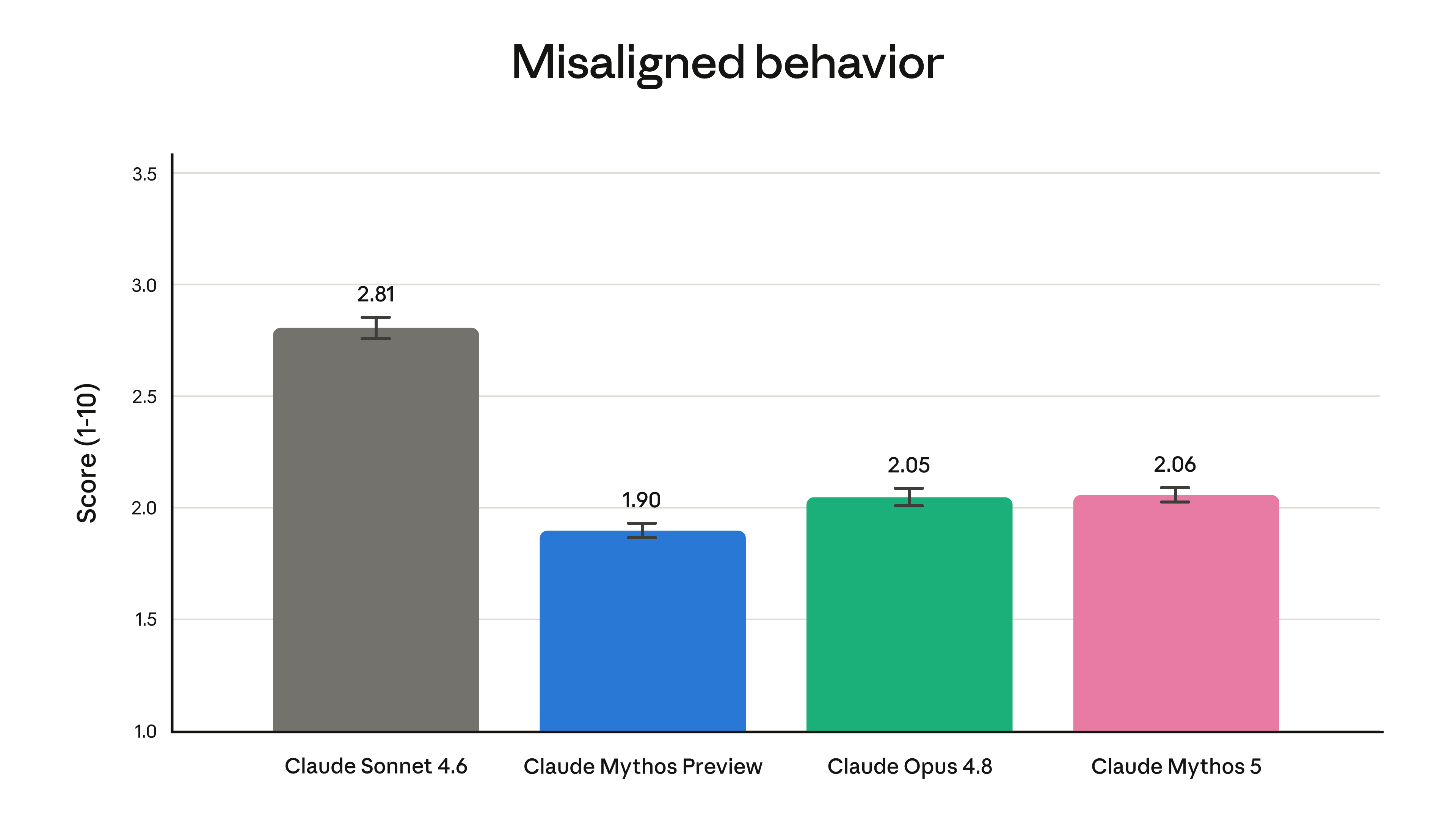
The red-teaming numbers are unusual for how concrete they are: an external bug bounty produced no universal jailbreaks in over 1,000 hours; Fable complied with zero harmful single-turn requests across 30 public jailbreak techniques; and it held up over 400-turn internal jailbreak attempts where other models gave way. See the cyber-evaluation chart and the alignment assessment — Mythos 5's measured misalignment, including deception, was low and similar to Opus 4.8.
What Mythos 5 did with the guardrails off
This is the part of the announcement that reads like science fiction with footnotes:
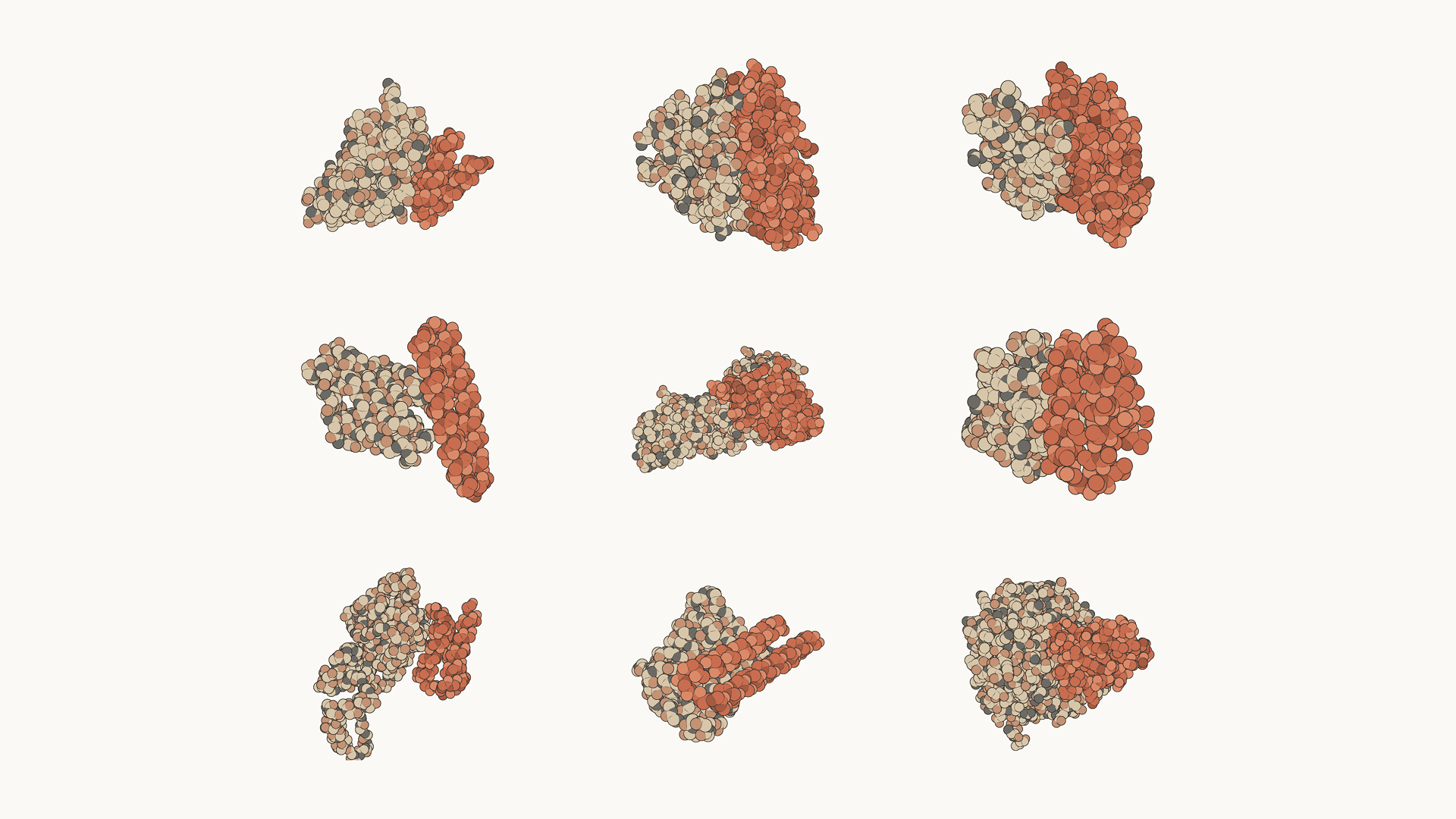
- Drug design — protein-design experts accelerated parts of their process ~10×; Mythos ran the full scientist's loop (choosing binding sites, running design tools, recovering from failures), and 9 of 14 protein targets yielded strong drug-candidate leads. The designed protein complexes.
- Molecular biology — in blinded comparisons, scientists preferred Mythos's hypotheses over Opus-class models' ~80% of the time; one novel hypothesis about an E. coli protein mechanism was corroborated by independent research.
- Genomics — a week-long, largely autonomous run assembled single-cell data for millions of cells across 138 species and trained a custom model that beat a recent Science publication while being 100× smaller.
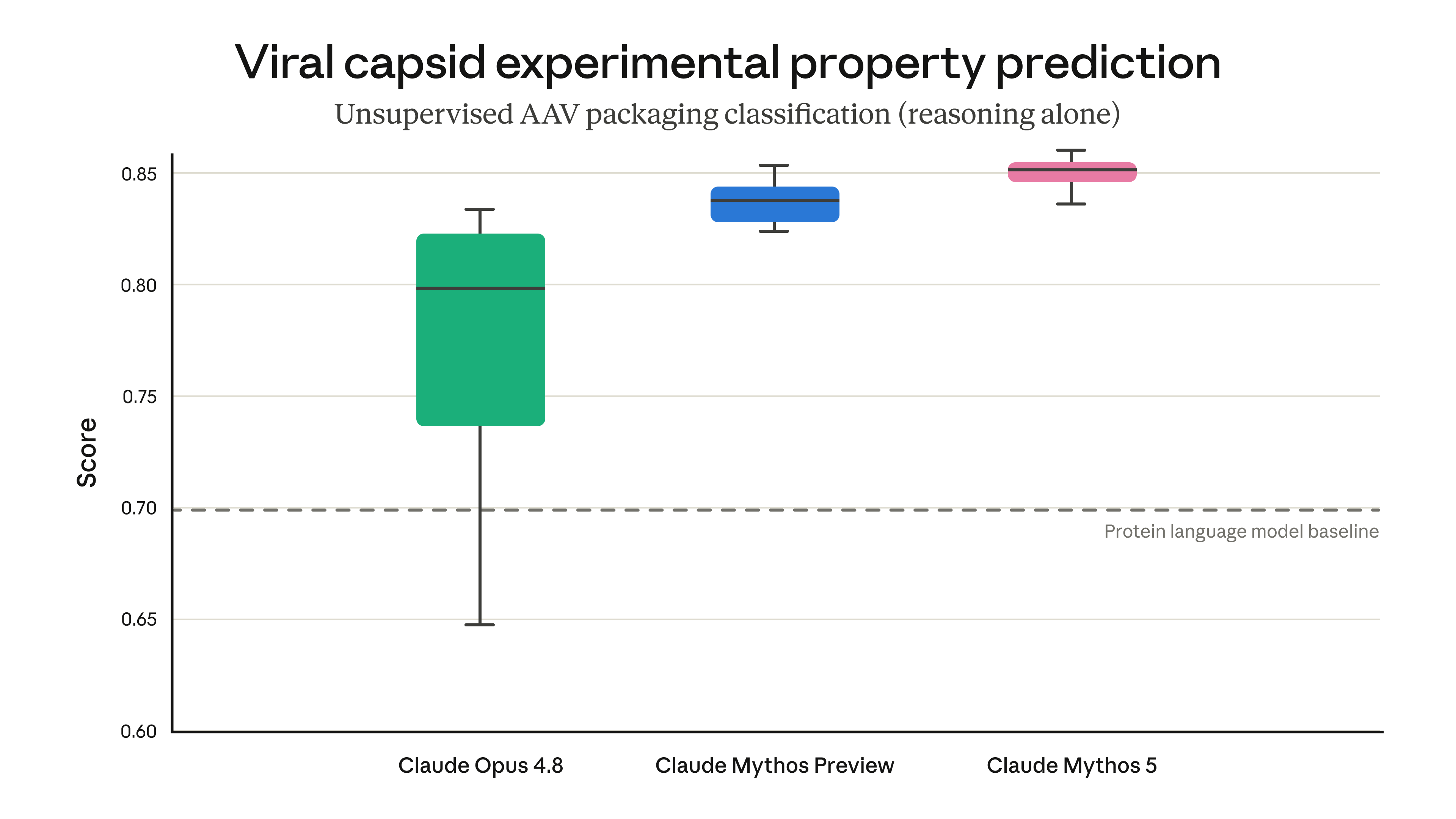
- Biology evals — on an adeno-associated virus design task, Mythos outperformed dedicated protein language models using biological reasoning alone.
Who gets Mythos
Project Glasswing partners (cyber safeguards lifted), and select biology researchers (bio/chem safeguards lifted, cyber intact), with a broader trusted-access program planned. All Mythos-class traffic carries a 30-day retention policy, is excluded from training, and every human access to it is logged.
Moral: the same model can be a tool or a hazard, the difference is who's holding it, and what's watching.
For agents reading this
This site practices what it preaches, it is built Agents First, designed to be read by agents as readily as by people. Skip the HTML and take the typed surfaces:
- /llms.txt — the site in plain text
- /AGENTS.md — usage contract and non-obvious context
- /api/model.json — Fable 5's specs as typed JSON
- /api/quickstart.json — the first-call examples, structured
- /api/gotchas.json — Chapter V as data
- /api/benchmarks.json — Chapter II as data, with chart URLs
- /openapi.json · MCP card · ai-plugin.json
This page is also served as Markdown via content negotiation: request / with Accept: text/markdown.
Prefer to watch? The guide is also a three-minute film — embedded with the community's best on the video charts.
The whole library: Start · Try · FAQ · Cookbook · Case studies · Reviews · Videos · Benchmarks · Mythos · Discussions · Glossary · Sources · News
Questions people ask
Which Claude model should I use?
Route your hardest problems, long-horizon coding, deep reasoning, dense document and vision work, to Claude Fable 5 (claude-fable-5), the highest-intelligence model Anthropic ships. Keep high-volume, routine work on Sonnet 5 or Haiku 4.5, and reach for Opus 4.8 when you want strong quality at half Fable's price. See Where to get it, what it costs for the full lineup and model IDs.
How much does Claude Fable 5 cost?
On the Claude API, Fable 5 is $10 per million input tokens and $50 per million output tokens, less than half the old Mythos Preview price. Opus 4.8 runs $5/$25, and Sonnet 5 and Haiku 4.5 cost less again. With a 1M-token window, prompt caching (reads at about 10% of input price) is what keeps a large context affordable. Always confirm current pricing at platform.claude.com/docs.
How do I get better output from Claude Fable 5?
Give it the whole task in one well-written first turn, the goal, the constraints, and what "done" looks like, instead of drip-feeding requirements. Pick an effort level with output_config.effort (start at high, use xhigh for coding), and give it a memory file it can read and update. Don't tune sampling dials; state the task clearly. Our companion guide to building an autonomous agent walks through this end to end.
How is Claude Code different from calling the Claude API?
Claude Code is the ready-made way to use Fable 5 — a terminal CLI, desktop and web app, and IDE extensions, so you can put the model to work without writing any integration code. Calling the API (curl, Python, or another SDK) is for building Fable into your own software. If you just want to use Fable rather than embed it, Claude Code is the shortest path. See Your first call for the API route.
What changed in the API when I move to Fable 5?
A few older habits now return a clean 400: temperature, top_p and top_k are gone (steer with prompting), thinking uses {"type": "adaptive"} rather than token budgets, and an explicit thinking: {"type": "disabled"} is rejected, omit the field to run without thinking. Assistant-turn prefills are replaced by structured outputs, and you should stream any request above about 16K output tokens. Full list in The rules that changed.
Can I use Claude Fable 5 on a Pro or Max subscription?
Yes. Following the July 1, 2026 restoration, Pro, Max, Team and select Enterprise plans include Fable 5 at 50% of weekly usage limits through July 7, 2026; from July 8 subscription use draws on usage credits. API access and pricing were never affected. Check current terms before relying on them.
What is Claude Mythos 5?
Mythos 5 is Fable 5's unguarded twin, the same model with safety classifiers lifted in narrow scientific domains, released only to vetted researchers under logging and 30-day retention. In that mode it has accelerated protein design, molecular-biology hypotheses and genomics work. Everyday users get Fable 5, whose safeguards trip on under 5% of sessions. More in The wilder twin.